1. What FinOps Is
FinOps sits between engineering, finance, and procurement, whether those teams planned for it or not.
Engineering owns delivery. Finance owns planning. Procurement owns contracts and commitments. Cloud made those responsibilities dependent on one another in ways most organizations were not prepared for.
FinOps gives these teams a shared way to talk about money as it moves through cloud and the rest of the technology stack. In practical terms, that means fewer surprises at the end of the month and fewer decisions made without financial context. It does not remove tradeoffs. It makes them visible.
As organizations moved from capital-heavy infrastructure to consumption-based services, older financial management tools stopped working well. They assumed stable usage and predictable invoices. Cloud introduced elasticity, variable pricing, and billing detail that changed weekly. Teams needed a practice that could keep up and still connect spend back to business value.
FinOps concepts include:
-
Assigning cost to owners and workloads Making cost data visible to both technical and financial teams
-
Using tagging standards that survive real-world usage
-
Tracking unit economics like cost per transaction or environment
-
Applying showback or chargeback where it actually drives behavior
-
Keeping a regular feedback loop between engineering and finance
These ideas have held up because the underlying problems have not gone away.
2. The economic forces behind FinOps
Traditional infrastructure spending was slow and predictable. Capacity was purchased upfront and depreciated over time. Mistakes were expensive, but they were also rare.
Cloud flipped that model:
-
Consumption now responds directly to demand.
-
Auto-scaling rules change usage by the hour.
-
Data moves across regions.
-
Storage grows quietly as logs, events, and user data accumulate.
-
Development teams spin up test environments that are meant to be temporary and sometimes are not.
None of this is temporary. Many teams assumed early cloud cost spikes would flatten out once things “settled.” In most cases, they didn’t.
Key economic forces include:
-
Elasticity that changes consumption throughout the day
-
Distributed architectures that shift data transfer costs
-
Microservices that multiply the number of billable components
-
Development cycles that expand the number of environments
-
Auto-scaling rules that respond faster than budgets do
-
Multi-cloud strategies that fragment billing SaaS adoption that adds contracts, pricing models, and renewal risk
These forces demand ongoing attention. FinOps does not eliminate them. It gives teams a way to recognize patterns early enough to act.
3. The FinOps framework
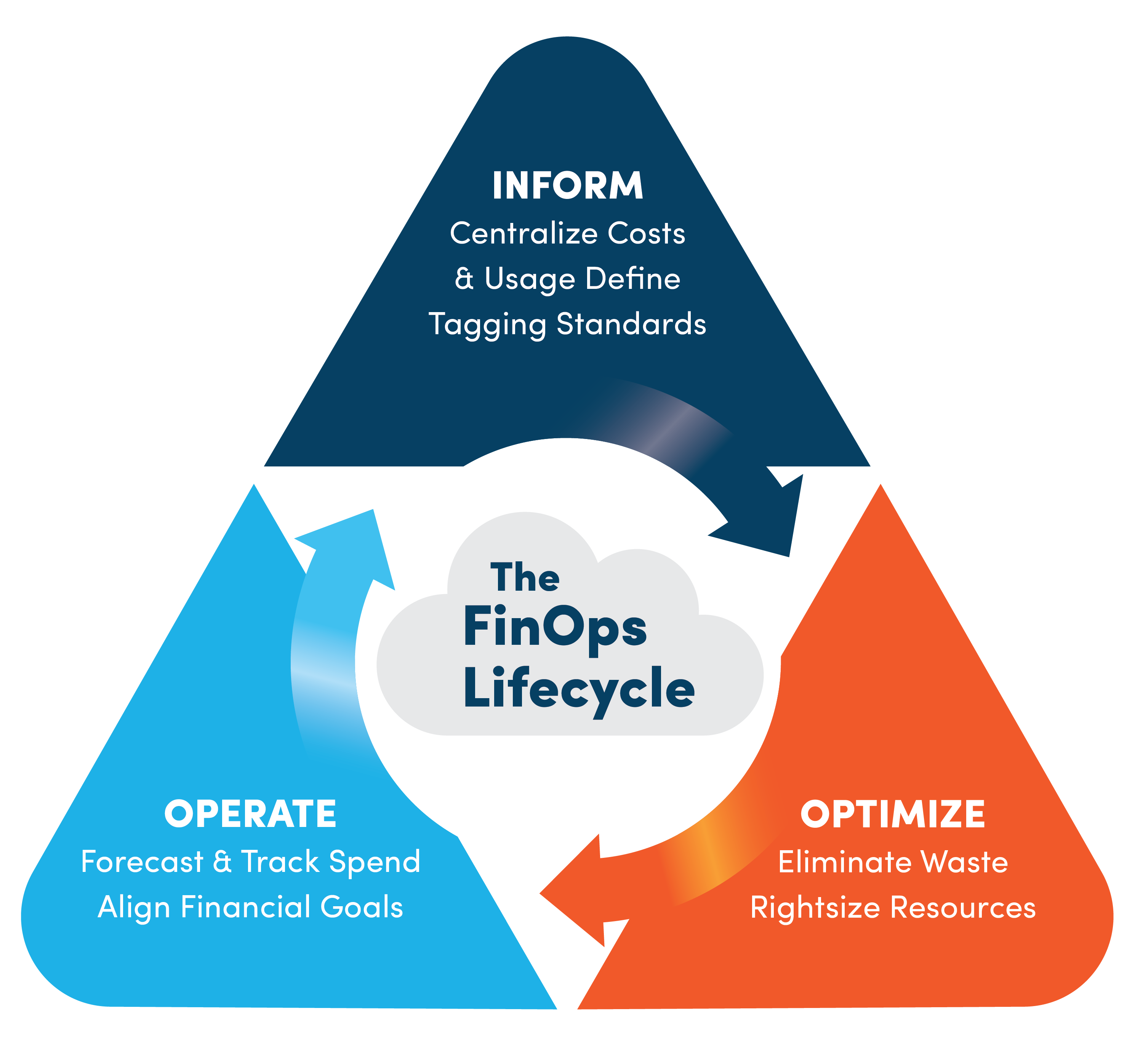
The FinOps Foundation describes a framework built around three phases. In practice, organizations move between them unevenly.
Inform
Teams start by building visibility.
-
Cost, usage, and invoice data are centralized.
-
Tagging standards are defined and tested against reality.
-
Data is normalized across clouds, networks, and SaaS platforms so reports stop contradicting each other.
Optimize
Once teams trust the data, they begin to act on it.
-
Resources are rightsized.
-
Obvious waste is removed.
-
Commitments are planned around workloads that stay stable.
-
Architectural choices are reviewed with cost and performance side by side.
Operate
This is where many programs struggle.
-
Reporting becomes routine.
-
Forecasts are reviewed and corrected.
-
Policies are updated when they fail.
-
Financial expectations are aligned with delivery plans.
-
FinOps becomes part of how decisions are made, not a separate exercise.
These phases overlap. Most organizations revisit Inform more often than they expect.
4. Technical foundations of FinOps
Every FinOps practice relies on a small set of technical capabilities. When these foundations are weak, even the best processes and intentions break down. When they are solid, teams can move faster with fewer debates about whose numbers are right.
Tagging
Tagging is the entry point for most FinOps programs, and also one of the most fragile. Without accurate and consistently applied tags, allocation becomes guesswork and forecasting loses credibility. Tags need to survive real-world behavior, including new services, rushed deployments, and changing team structures. A tagging strategy that only works in theory will not hold up for long.
Account and inventory structure
How accounts and services are organized determines how easily spend can be understood and owned. Grouping by workload, team, environment, or service inventory makes reporting more intuitive and reduces manual reconciliation. Inventory matters just as much as accounts. Teams need a clear view of what is active, what is no longer needed, and who is responsible for each service.
Data normalization
Cloud providers, carriers, and SaaS platforms describe usage and pricing in different ways. Left untouched, this makes comparisons misleading and trends difficult to spot. Normalization creates a common language for usage and cost so teams can analyze data across environments without reinterpreting it each time.
Unit economics
Unit economics connect technical consumption to business outcomes. Metrics such as cost per customer, transaction, or environment help teams understand whether spend is scaling in the right direction. These measures are most useful when they are reviewed regularly and tied back to architectural or product decisions.
As environments expand and diversify, these foundations matter more, not less. They determine whether FinOps remains a usable operating model or turns into a reporting exercise teams stop trusting.
5. Why FinOps Matters
Cloud is not a single line item, and neither is the technology stack that supports it. Modern environments span infrastructure, platforms, data services, networking, SaaS applications, and managed services, often spread across multiple providers. Hybrid and multi-cloud architectures increase flexibility, but they also multiply variables that affect cost.
Without a clear operating model, spending in these environments becomes difficult to explain and even harder to predict. Costs shift in response to traffic, architectural changes, and product decisions that may be made far from finance or procurement. Over time, this disconnect leads to missed forecasts, reactive cost controls, and decisions based on incomplete information.
FinOps provides a way to operate within this complexity. It creates a shared understanding of how technical decisions translate into financial outcomes and brings cost conversations closer to where those decisions are made.
-
Engineers see how design and scaling choices affect cost, often early enough to adjust them.
-
Finance builds forecasts that reflect how systems actually behave, not how models assume they should.
-
Procurement negotiates commitments and renewals using real usage patterns rather than static estimates.
-
Leadership sees tradeoffs between cost, performance, and growth instead of isolated totals.
As cloud adoption matures, FinOps has shifted from a niche practice to an operational requirement. Organizations that treat it as such are better equipped to manage change without losing financial control.
6. Governance as a long-term accelerator
Governance is what keeps FinOps effective after the initial momentum fades. Early wins often come from visibility and quick optimizations, but without governance those gains tend to erode. Standards slip, ownership blurs, and teams fall back into reactive behavior. Effective governance does not mean heavy approvals or centralized control over every decision. It creates clear expectations around how cost is reviewed, how issues are escalated, and how tradeoffs are made. When these expectations are consistent, teams spend less time debating process and more time acting on data.
Common governance practices include:
-
Architectural cost reviews that surface tradeoffs before changes reach production
-
Regular FinOps reviews with engineering that focus on trends, not blame
-
Forecast and budget calibration to account for changes in demand or delivery plans
-
Automated enforcement of tagging and lifecycle rules to reduce manual cleanup Contract and commitment reviews ahead of renewal cycles, when options still exist
-
Clear paths for resolving anomalies and billing issues so problems do not linger
These practices create a feedback loop. Issues are identified earlier, decisions are documented, and patterns become easier to spot over time. Teams learn which actions lead to predictable outcomes and which introduce unnecessary risk.
Good governance does not slow teams down. It reduces rework, prevents the same mistakes from repeating, and allows organizations to scale their environments without losing financial control.
7. How to get started
FinOps starts with structure. Tools and dashboards come later. Without a clear operating model, even good data ends up unused.
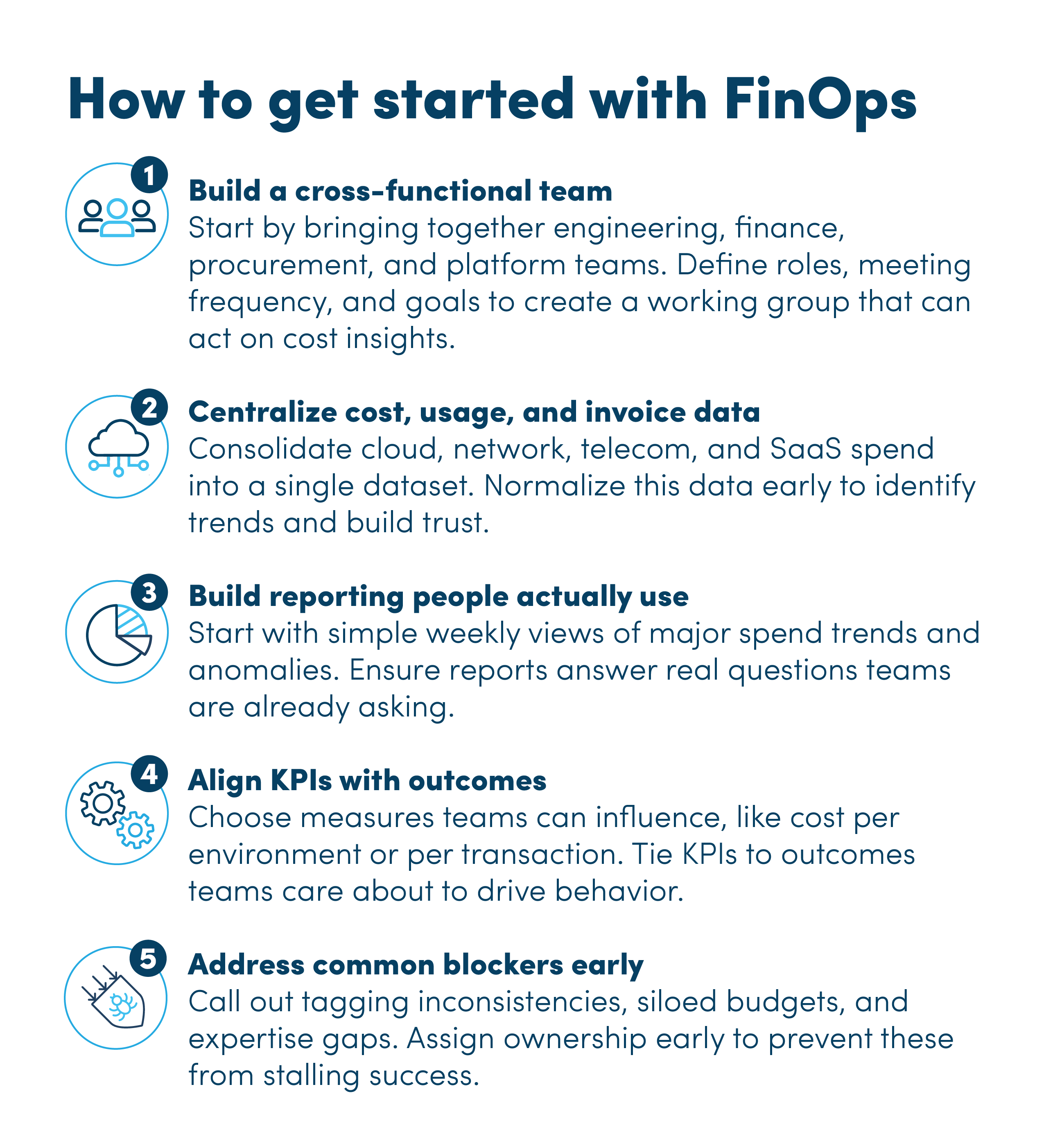
1. Build a cross-functional team
Start by bringing together engineering, finance, procurement, and platform teams. Define who owns which decisions, how often the group meets, and what outcomes the team is responsible for. This is not a steering committee. The goal is to create a working group that can act on cost insights, not just review them.
2. Centralize cost, usage, and invoice data
Pull cloud, network, telecom, and SaaS spend into a single dataset. Fragmented data leads to fragmented decisions. Normalizing this information early makes it easier to spot trends, explain variances, and build trust in the numbers across teams.
3. Build reporting people actually use Start small. Weekly views of spend trends, major drivers, and anomalies are more useful than dense monthly reports no one reads. Reports should answer real questions engineers and finance teams are already asking, not introduce new metrics without context.
4. Align KPIs with outcomes
Choose measures teams can influence, such as cost per environment, per transaction, or per customer. When KPIs are tied to outcomes teams care about, FinOps stops feeling like oversight and starts influencing behavior.
5. Address common blockers early
Most FinOps programs slow down for the same reasons: inconsistent tagging, disconnected billing systems, limited FinOps expertise, siloed budgets, and tools designed for fixed spend. These issues rarely resolve themselves. Calling them out early and assigning ownership prevents them from becoming long-term constraints.
8. FinOps tools and technologies
FinOps tools support visibility, analysis, and action, but no single tool category solves every problem. Most organizations end up using a combination, especially as environments become more hybrid and multi-vendor over time.
Three tool categories show up consistently across FinOps practices.
1. Cloud-native tools
Every major cloud provider offers native cost and usage tools. These are often the starting point for FinOps teams because they are readily available and closely integrated with platform services. They provide detailed visibility into provider-specific usage and can support basic allocation and optimization within a single cloud.
Their limitations appear as environments expand. Native tools do not normalize data across providers, struggle to incorporate non-cloud services, and offer limited support for invoice validation, contracts, or cross-functional reporting.
2. Third-party FinOps platforms
Third-party FinOps platforms extend visibility across multiple cloud providers. They normalize usage and pricing data, support forecasting and budget tracking, and introduce governance features such as anomaly detection and policy enforcement. These platforms are well suited for organizations managing multiple cloud environments that need consistent reporting and shared metrics.
However, they typically remain focused on cloud infrastructure. Network, telecom, and SaaS spend are often handled separately, and contract and invoice accuracy may sit outside their scope.
3. Technology Expense Management platforms
Technology Expense Management platforms broaden the FinOps view beyond cloud alone. They unify visibility across cloud, network, telecom, and SaaS, and place greater emphasis on financial accuracy, invoice validation, and contract oversight. Inventory and service tracking play a central role, supporting governance across diverse environments.
These platforms are designed for organizations where technology spend extends well beyond hyperscalers and where billing complexity creates real financial risk.
Pure IP FinOps sit in this category. It supports hybrid environments and pairs unified visibility with managed services, helping teams maintain accuracy, governance, and follow-through as environments scale.
Tooling choices depend on scope and maturity. As FinOps programs evolve, many organizations find that cloud-only tools no longer reflect the full financial picture they are responsible for managing.
| Capability |
Cloud-Native Tools |
Third-Party FinOps Platforms |
Technology Expense Management Platforms |
| Primary focus |
Single-provider cloud visibility |
Multi-cloud cost management |
End-to-end technology spend |
| Cloud coverage |
One provider at a time |
Multiple cloud providers |
Multiple cloud providers |
|
Network & telecom
spend
|
Not supported |
Limited or external |
Native support |
| SaaS spend |
Not supported |
Partial or manual |
Native support |
| Data normalization |
Provider-specific only |
Cross-cloud normalization |
Cross-domain normalization |
| Invoice validation |
Minimal |
Limited |
Core capability |
|
Contract & renewal
visibility
|
Minimal |
Partial |
Centralized and enforced |
|
Inventory & service
tracking
|
Limited |
Cloud-focused |
Full service inventory |
|
Forecasting &
budgeting
|
Basic |
Strong for cloud |
Strong across domains |
|
Governance & policy
enforcement
|
Provider-specific |
Cloud-centric |
Cross-technology governance |
|
Managed services &
analyst support
|
Not included |
Rare |
Common |
| Best suited for |
Early cloud adoption |
Multi-cloud cost control |
Hybrid, complex environments |
9. Evaluating FinOps vendors
FinOps vendors vary widely in both depth and operating model. Some focus on visualization and reporting, while others take responsibility for ongoing accuracy, governance, and follow-through. Understanding this difference upfront helps avoid mismatched expectations later.
When evaluating vendors, capability matters, but so does how the service is delivered.
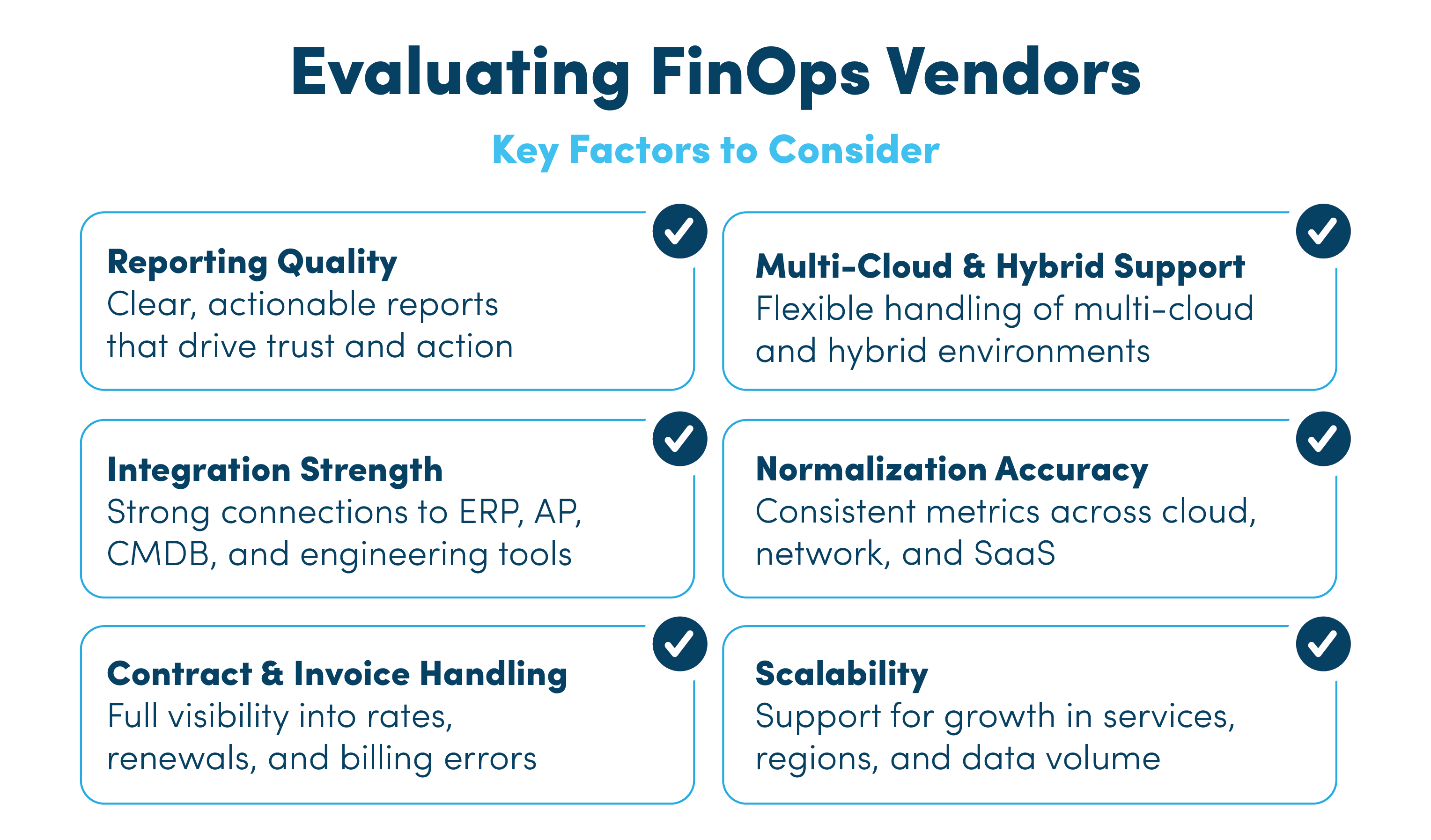
Key factors to consider include:
-
Reporting quality: Reports should explain cost drivers clearly and remain usable as environments change. Visuals matter less than whether teams trust and act on the data.
-
Multi-cloud and hybrid support: As environments spread across providers and platforms, tools must handle different pricing models, units, and billing structures without manual workarounds.
-
Integration strength: Connections to ERP, AP, CMDB, and engineering systems determine whether FinOps insights can influence real processes like forecasting and approvals.
-
Normalization accuracy: Consistent metrics across clouds, networks, and SaaS are essential for trend analysis and comparison. Inaccurate normalization creates false confidence.
-
Contract and invoice handling: Visibility into rates, renewals, and billing errors prevents financial leakage that dashboards alone cannot catch.
-
Scalability: The vendor should support growth in services, regions, and data volume without increasing manual effort.
Operating model is just as important as features. Tool-only vendors typically stop at dashboards and alerts. They surface issues but leave investigation, resolution, and follow-up to internal teams. This can work when FinOps is well staffed and mature.
Managed FinOps vendors take responsibility for outcomes. That includes recovering credits, correcting invoices before payment, enforcing contracts, and improving forecast reliability over time. The difference shows up in consistency and follow-through, not just in reporting.
10. Pure IP FinOps
Pure IP FinOps is built for organizations where technology spend has outgrown cloud-only visibility and financial accuracy is harder to maintain.
As environments scale, costs spread across cloud, network, telecom, and SaaS. Invoices arrive in different formats. Contracts renew on different cycles. Teams end up reconciling spend after the fact instead of managing it as it changes.
Pure IP FinOps brings order to that reality by focusing on accuracy first and provides:
-
A single view of cloud, network, telecom, and SaaS spend
-
Invoice validation before payment, not after issues surface
-
Digitized service inventory tied to real usage
-
Contract and rate enforcement across providers
-
Ongoing audits, dispute support, and cost recovery
-
Reporting teams can trust for forecasting and planning
Instead of treating optimization as a one-time exercise, Pure IP FinOps supports continuous oversight as environments change.