Large organizations are retiring their on-premises phone systems, and the reasons stack up fast: aging PBX estates that cost a lot to maintain, hybrid work that assumes people can call from anywhere, old lines being switched off by carriers, and constant pressure to consolidate tools and contracts. Moving voice to the cloud answers all four. What makes the decision harder at enterprise scale is everything that comes with size, more sites, more countries, more integrations, and more that can go wrong in a migration. Getting it right starts with being clear on what a cloud-based phone system is.
What is a cloud-based phone system?
A cloud-based phone system is business calling delivered as a service. The calling, routing, and phone features live on a provider's platform and reach your people over the internet, instead of running on hardware in your own server room. Users make and take calls on desk phones, softphones on their laptops, mobile apps, or inside a collaboration platform, while the provider runs the infrastructure behind it.
A cluster of terms gets used for much the same idea. Cloud telephony and hosted telephony both describe calling run from a provider's platform rather than on-site equipment. Cloud voice and cloud-based VoIP name the same delivery model with the emphasis on voice traffic carried over IP networks. Cloud-based telephone service and cloud-based phone service are simply everyday labels for the product. The distinction worth holding onto is the one with VoIP itself: Voice over IP is the underlying technology that turns calls into data and sends them across the internet, and a cloud-based phone system is one way of delivering VoIP, with the platform hosted and managed for you rather than sitting in your building.
How cloud phone systems work in a large organization
In a large business, a cloud phone system is a provider-hosted platform that connects your organization to the public phone network and ties together everyone who needs to make a call. Employees use whatever suits their role: a desk phone in a call-heavy team, a softphone or mobile app for people on the move, or the calling built into a collaboration platform. It all runs through the same system, and administration is centralized, so IT manages users, numbers, and policies across every site and region from one place rather than maintaining separate systems building by building.
Three layers sit underneath that experience, and it helps to keep them distinct. The platform provides the calling features and the interface people use. The carrier supplies the connection to the public phone network, the phone numbers, and the in-country compliance that makes regulated calling legal in each market. The network carries the traffic, and its quality determines what callers really hear. At enterprise scale, how well those three fit together across dozens of locations is what separates a clean deployment from a patchy one.
Deployment models for large businesses
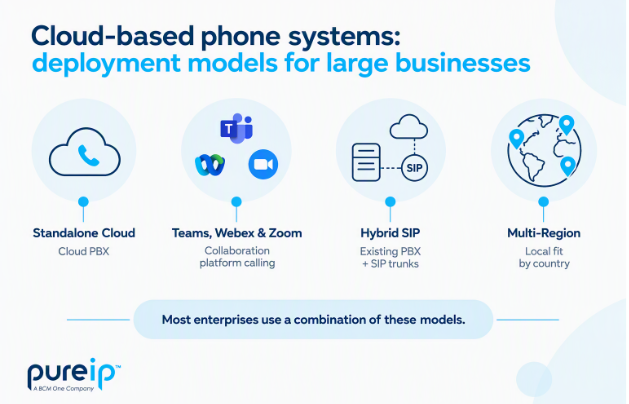
There's no single shape for enterprise cloud voice, and most large businesses land on one of a few models or a blend of them:
- A standalone cloud phone system: the provider's platform is your phone system, used directly through its own apps and devices.
- Voice delivered into Teams, Webex, or Zoom Phone: calling runs inside the collaboration platform your people already use, with a provider connecting it to the public network.
- Hybrid, with SIP trunking into an existing PBX: parts of the old estate keep running, connected by SIP trunks, while you move sites across in stages.
- A mix across regions: different models in different countries, chosen to fit local coverage, regulations, and what's already in place.
Blended setups are common at scale, because a business with dozens of sites rarely fits one mold everywhere. It's normal to run collaboration-platform calling in most offices, a standalone system in a contact-center-heavy site, and hybrid SIP trunking where a PBX still has life left in it.
Why large businesses move to the cloud
The case for moving gets stronger the larger the organization:
- Consolidation: one platform and far fewer carrier contracts, in place of a patchwork built up site by site over the years.
- Scalability: adding users, opening sites, or absorbing an acquisition becomes a configuration change rather than a hardware project.
- Resilience: geo-redundant infrastructure and built-in failover are hard and expensive to replicate with on-premises equipment.
- Support for distributed teams: hybrid and remote workers get the same calling experience wherever they are, on any device.
- Platform alignment: calling lives inside the collaboration tools employees already spend their day in, which lifts adoption and eases support.
For a business carrying several PBX systems across multiple countries, those benefits compound. Each retired system removes a maintenance contract, a refresh cycle, and a set of local support headaches.
What large businesses need to evaluate
The upside is clear, but at scale the details decide whether a migration goes smoothly. A few areas deserve close attention before you commit.
Global coverage and local numbers
Check that your provider can supply and port numbers in every country you operate in, not just your headquarters market, and that it meets the in-country regulatory requirements for offering voice there. Porting timelines and local rules vary widely, and a provider that's strong in one region can be thin in another.
Call quality and network design
Voice is sensitive to network conditions, so plan quality of service, bandwidth, and network readiness site by site. It also matters whether calls travel over a managed or owned network with predictable performance, or over best-effort public internet, which is harder to guarantee across a large footprint.
Integration
Map what the phone system needs to connect to: collaboration platforms, contact center, call recording, and CRM. Confirm the provider is certified or approved for the platforms you run, since an unsupported integration is a common place for deployments to stall.
Security, compliance and emergency calling
Look at encryption, toll-fraud protection, and access controls, then layer on the rules specific to your business: call-recording obligations, data residency, and any regulated-industry requirements. Emergency calling needs particular care at scale, because remote and hybrid users move around, and their location has to resolve correctly the moment they dial an emergency number.
Reliability and support
Read the SLAs closely and understand what they cover. Just as important is the support model, since escalation paths, named contacts, and follow-the-sun coverage matter when you run voice across time zones and something breaks at 2am in one of them.
Governance and management
At enterprise scale you want centralized administration with room for regional control, so global policy and local autonomy can coexist. Reporting, analytics, and a clear change-management process keep a large deployment manageable as it grows and shifts. Because at enterprise scale, a cloud migration succeeds or fails on how well you understand the estate you're leaving behind.
Types of cloud-based phone systems
Most large businesses build their cloud phone system on one of the major collaboration platforms, because calling then lives in the same app people already use for meetings and messaging. The three most common are Microsoft Teams Phone, Webex Calling, and Zoom Phone. Each turns its platform into a full phone system, and each still needs a connection to the public phone network, which is where a voice provider comes in.
Microsoft Teams Phone
Microsoft Teams Phone adds full calling to Microsoft Teams, so people make and take external calls in the same app they already use for meetings and chat. It connects to the public network in a few ways, through Microsoft Calling Plans, Operator Connect, or Direct Routing, and it's the natural fit for organizations already standardized on Microsoft 365. For large, Teams-first businesses, it keeps voice inside a platform users know and IT already manages.
Webex Calling
Webex Calling is Cisco's cloud calling built into Webex, bringing calling together with Webex meetings, messaging, and devices. It connects to the public network through Cisco Calling Plans, Cloud Connected PSTN, or a premises-based gateway, and it suits organizations invested in the Cisco and Webex ecosystem, particularly those with established Cisco devices or contact center estates.
Zoom Phone
Zoom Phone extends Zoom beyond meetings into a full cloud phone system, so calling sits alongside the video platform many teams already live in. It can use Zoom's own calling plans or bring in an external carrier for PSTN connectivity, and it appeals to organizations that standardized on Zoom and want their telephony in the same place.
Whichever platform you choose, the pattern is the same: the platform provides the calling experience, and a carrier connects it to the outside world, so the evaluation points above apply regardless of which one you land on.
Challenges to plan for at scale
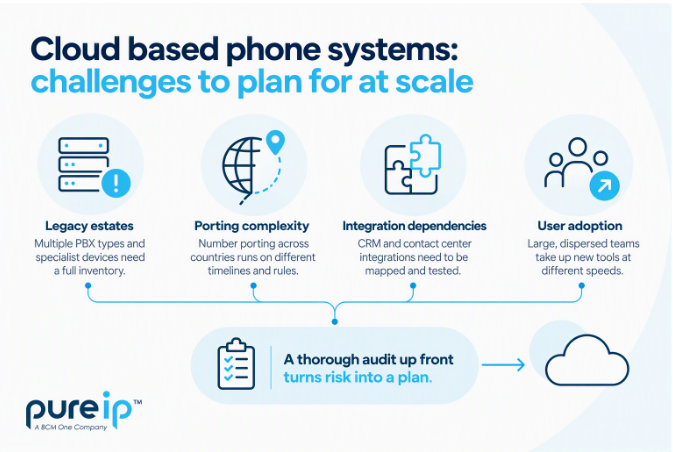
None of these should stop a move to the cloud, but each is worth planning for rather than discovering mid-migration:
- Legacy estates: multiple PBX types, plus alarm lines, elevators, fax, and specialist devices, need an inventory and a device-by-device plan before anything is switched off.
- Porting complexity: number porting across countries runs on different timelines and rules, so it's sequenced country by country rather than attempted all at once.
- Integration dependencies: a missed connection to a CRM or contact center can break a workflow, which is why integrations are mapped and tested before cutover.
- User adoption: large, dispersed teams take up new tools at different speeds, so training and a phased rollout matter as much as the technology.
The thread running through all of them is the same. The risk comes from what you haven't mapped, so a thorough audit up front is what turns each of these from a surprise into a task.
How much does a cloud phone system cost for a large business?
Pricing for a cloud-based phone system usually follows one of a few commercial models: per user per month, usage-based, a bundle that includes calling, or an enterprise agreement negotiated across the whole organization. What you pay is shaped by the countries you need coverage in, your call volumes, the integrations and hardware involved, and the migration and managed services you take on.
The more useful comparison at enterprise scale is total cost of ownership rather than a per-user headline. Maintaining a PBX estate carries costs that are easy to overlook: hardware refresh cycles, maintenance contracts, multiple carrier relationships, and line rental across every site. Set against those, a consolidated cloud platform often changes the shape of the spend as much as the size of it. Because the variables differ so much between organizations, a costed proposal based on your actual estate will tell you far more than any published price.
How large businesses switch from PBX to the cloud
A large migration works best as a sequence rather than a single switch-over:
- Audit the estate. Document every site, user, number, call flow, integration, and contract, so you know exactly what you're moving and what depends on it.
- Prepare the network site by site. Confirm bandwidth, QoS, and readiness at each location before any users go live.
- Plan porting and legacy devices. Sequence number porting by country, and decide what happens to alarms, elevators, fax lines, and other specialist devices at each site.
- Pilot in one region or business unit. Prove the setup with a contained group, then fix what the pilot surfaces before you scale.
- Roll out in phases. Move site by site or region by region, with coexistence so old and new run side by side, and a rollback plan if something needs more time.
- Decommission the old estate. Retire PBX hardware and close down legacy carrier contracts once each site is fully live, so you stop paying for what you've replaced.
Choosing a partner for enterprise cloud voice
At this scale, the provider matters as much as the platform. What you want is global reach across the countries you operate in, hands-on migration support, managed services that take operational load off your team, and the ability to support a hybrid estate through the transition rather than forcing a big-bang cutover.
This is where Pure IP fits. Pure IP delivers enterprise cloud voice across standalone, collaboration-platform, and hybrid models, with global number coverage, in-country compliance, and migration and managed services built for large, multi-country estates. If you’re scoping a move, talk to our team.
Final thoughts
A cloud-based phone system gives a large business one platform for calling across every site and country, with the scale, resilience, and integration an aging PBX estate can't match. The technology is well understood at this point. What makes an enterprise migration succeed is the groundwork: knowing your estate, planning porting and integrations, and rolling out in phases with the right partner alongside you. Do that, and voice becomes one less thing your organization has to maintain, and one more thing that simply works wherever your people are.
Frequently asked questions
What happens to my cloud phone system if the internet goes down?
Because a cloud-based phone system runs over the internet, a site's calling depends on its connection. Well-designed deployments plan for that: calls can fail over automatically to mobile apps on cellular, to another site, or to backup routing, so an outage in one location doesn't take calls down everywhere. For critical sites, a second internet connection or a resilient managed network keeps voice running even if the primary link drops.
Can I keep my existing phone numbers when I switch to a cloud phone system?
Yes. Number porting moves your existing numbers to the new provider, and it's a standard part of any migration. At enterprise scale the effort is in the coordination, because porting runs on different timelines and rules country by country, so it's planned and sequenced rather than done all at once, with old services kept live until each port completes.
How much does a cloud phone system cost?
It depends on the commercial model (per user, usage-based, bundled, or an enterprise agreement) and on your countries, call volumes, integrations, hardware, and any migration or managed services. At scale, the figure that matters is total cost of ownership compared with maintaining a PBX estate, so a proposal based on your actual footprint is more meaningful than a per-user headline.
Which cloud-based phone system is the best?
There's no single best system, only the one that best fits your requirements. For a large business, the deciding factors are usually global coverage and number availability, the integrations you depend on, call quality and network design, security and compliance, and the strength of migration and ongoing support. The more useful question is which provider fits your estate, your countries, and the platforms your people already use.