
Most large enterprise Microsoft Teams Phone deployments end up running Operator Connect in some countries and Direct Routing in others. Few planned it that way from the start.
The decision usually happens in stages. A project team chooses Operator Connect for a core set of markets. Provisioning moves quickly through the Teams Admin Center. The migration looks like it's on track. Then someone asks what happens in Germany. Or Brazil. Or the three countries where the chosen operator has no PSTN coverage. Direct Routing fills the gap. Six months into the project, the deployment is hybrid.
Microsoft supports Operator Connect and Direct Routing running in the same tenant simultaneously. Most global enterprises end up using both: Operator Connect where the provider has PSTN coverage, Direct Routing for markets and scenarios outside that footprint. The accountability question is harder. Each model has a separate support path. Call failures that cross both layers can fall between them.
Why Teams Phone deployments end up hybrid
Microsoft Calling Plans cover roughly 30 to 35 countries. Operator Connect extends that reach, but only as far as the operator's own PSTN footprint allows. For enterprises with offices beyond that footprint, Direct Routing fills the gap.
Geography isn't the only driver. Analog device integration and legacy PBX coexistence during phased rollouts also push toward Direct Routing. So do regulatory requirements that mandate on-premises call routing. These scenarios arise in countries where the operator has full Operator Connect coverage.
Hybrid is rarely an edge case anymore. It’s becoming the default architecture for any enterprise running Teams Phone at scale across multiple countries.
What Operator Connect covers and where it stops
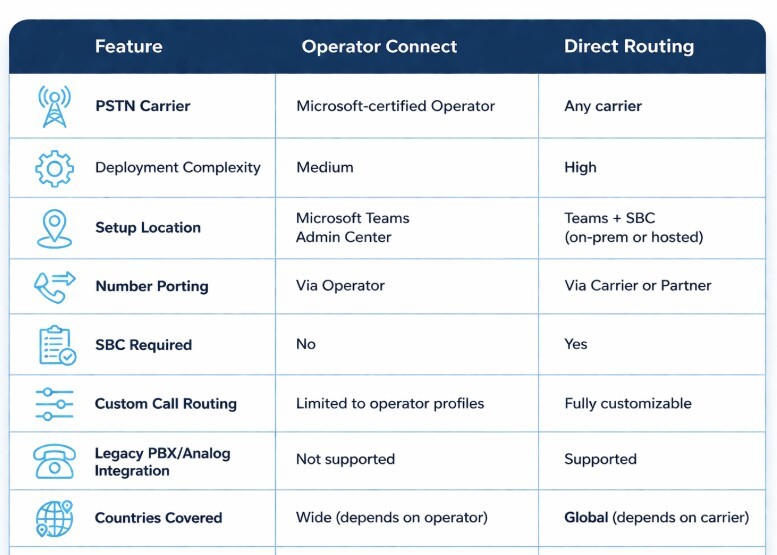
Operator Connect moves provisioning into the Teams Admin Center. A certified operator delivers PSTN connectivity directly. Number assignment is managed from the same console the team already uses for everything else in Teams. No Session Border Controller (SBC) to own, no routing configuration to maintain.
For core markets with standard dial plans, it is the faster path to go-live. The constraint is the operator's footprint. If the provider doesn't have PSTN replacement coverage in a specific country, Operator Connect doesn't help there. The gaps are visible in the Teams Admin Center before deployment. They are also frequently discovered after it.
What Direct Routing fills in
Direct Routing connects Teams Phone to the PSTN through an SBC, either on-premises, in the cloud, or delivered as a managed service. It covers markets outside the operator's Operator Connect footprint. It integrates with analog devices and legacy PBX infrastructure. It handles call routing requirements that Operator Connect's framework doesn't support.
The tradeoff is complexity. A self-managed SBC requires ongoing configuration and certificate maintenance. When something fails, troubleshooting demands telephony expertise that not every IT team has in-house. Direct Routing as a Service removes the infrastructure burden, but it introduces a separate provider relationship with its own support path.
The accountability gap in a hybrid deployment
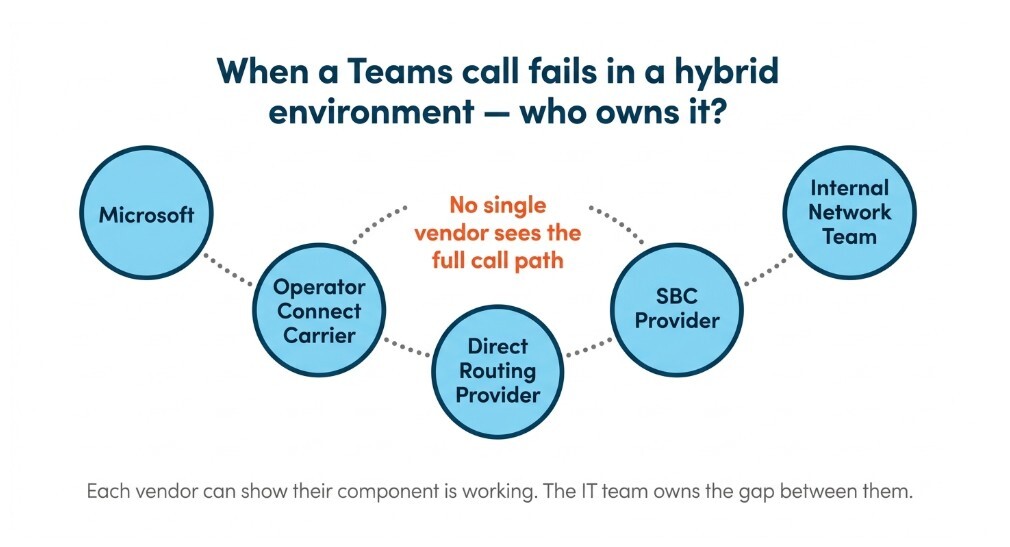
When a Teams call fails in a hybrid environment, the first question is: which layer is the problem in?
On Operator Connect, the operator's support team owns the call path. On Direct Routing, the SBC provider and the carrier both have a piece of it. When a call traverses both models, in a transfer scenario for example, the support escalation touches Microsoft, the Operator Connect carrier, the Direct Routing provider, and the network team.
Each vendor can show their component is working. What none of them can do is see the full call path. The IT Director running the hybrid deployment owns the gap between them.
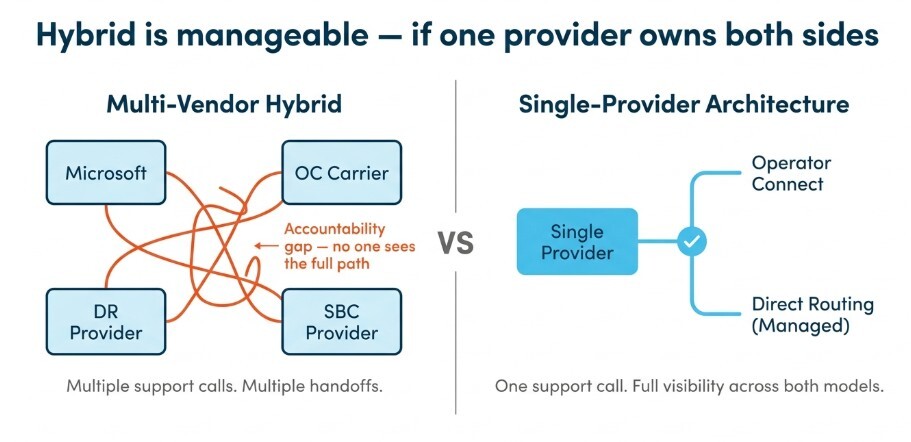
A single-provider architecture changes the operational reality. When one provider delivers both Operator Connect for core markets and managed Direct Routing for coverage gaps, the support path is one call. The provider has visibility across both connectivity layers. Call failures that cross the boundary between models don't fall into a gap where no single vendor has the full picture.
What a deliberately architected hybrid looks like
The most common enterprise pattern runs Operator Connect in high-volume countries where the provider has full PSTN coverage. Managed Direct Routing covers markets outside that footprint, sites with legacy coexistence requirements, and locations where compliance mandates on-premises routing.
Pure IP holds Microsoft certification for Operator Connect and delivers Direct Routing as a managed service. Enterprises running a global Teams Phone migration can provision Operator Connect in core markets through the Teams Admin Center. Pure IP manages SBC configuration and carrier connectivity for Direct Routing deployments in parallel. One provider covers both models, which means one support path and a single view of the call path regardless of which connectivity model is in play.
How to assess whether your current hybrid has a single accountable provider
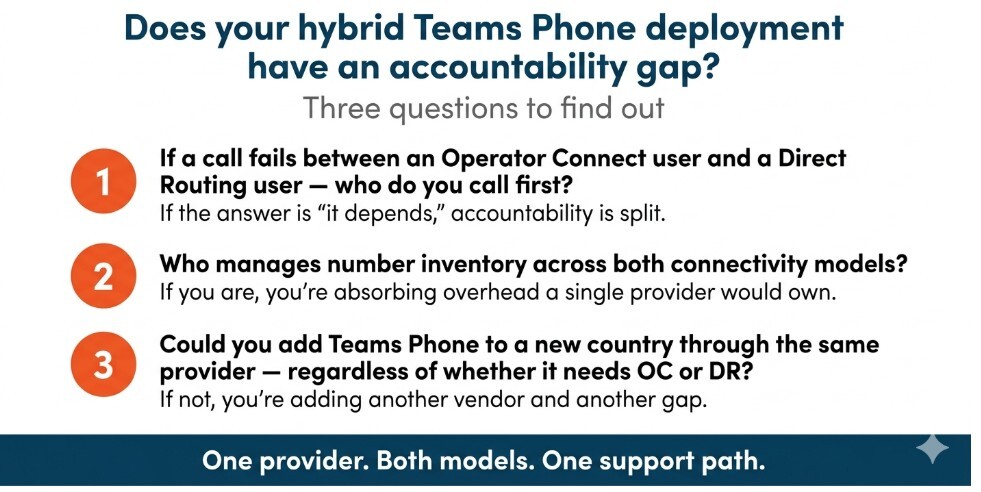
These questions identify whether your hybrid deployment has an accountability gap.
- If a call fails today between a user on Operator Connect and a user on Direct Routing, who do you call first? If the answer is "it depends," the accountability is split.
- If your Operator Connect provider doesn't cover a country where you have Direct Routing, who manages the number inventory across both? If you're managing it internally, you're absorbing overhead that a single provider would own.
- If you needed to add Teams Phone to a new country next quarter, could you provision through the same provider regardless of whether it required Operator Connect or Direct Routing? If the answer is no, you'll be adding another vendor relationship and another accountability gap.
Frequently asked questions
Can you mix Operator Connect and Direct Routing in the same Microsoft Teams tenant?
Yes. Microsoft supports both models running in the same tenant. Some users can be on Operator Connect while others use Direct Routing. In specific scenarios, the same user can have both, such as routing calls to a third-party PBX via Direct Routing while standard PSTN calls go through Operator Connect.
Who owns call quality in a hybrid Teams Phone deployment?
It depends on who the providers are. In a split-provider hybrid, Operator Connect call quality is the operator's responsibility. Direct Routing quality is split between the SBC provider and the carrier. Microsoft owns the platform layer. When a failure crosses both layers, fault isolation requires input from all of them. A single provider delivering both Operator Connect and managed Direct Routing has visibility across the full call path.
What's the difference between managed Direct Routing and Operator Connect?
Operator Connect integrates provisioning into the Teams Admin Center and uses Microsoft's peering infrastructure between operator and cloud. Direct Routing connects Teams to the PSTN through a certified SBC, which can be customer-managed or delivered as a managed service. Managed Direct Routing removes the SBC infrastructure burden while retaining the geographic flexibility of Direct Routing. For enterprises running both models, the most operationally relevant distinction is which provider owns each call path.

.png?width=405&height=200&name=Cloud-based%20phone%20systems%20for%20large%20businesses%2c%20explained%20(1).png)