
Most organizations discover what they're overpaying on telecom the same way. Someone runs an audit, and the number is larger than anyone expected.
The audit itself isn't complicated in principle. It's time-consuming, it requires carrier-side data that isn't always easy to get, and it surfaces findings that need to be acted on — which is where most internal audit efforts stall.
This is a practical walkthrough: what a telecom expense audit covers, how to run one step by step, what it typically finds, and what to do once you have the results.
What a telecom expense audit is
A telecom expense audit is a systematic reconciliation of carrier invoices against contracted rates, active service records, and inventory. The output is a specific list of billing errors, unused services, and contract non-compliance items — each with a dollar value and a recommended action.
Two types are worth distinguishing before you start:
- A point-in-time audit reviews a defined period, usually 12 to 24 months of invoices. It identifies what went wrong over that period and produces a recovery opportunity - charges that can potentially be disputed and credited. The limitation is that payment has already cleared on most of what it finds.
- An ongoing audit process validates every invoice in the billing cycle it arrives, before payment clears. It prevents future overpayment rather than recovering past overpayment.
Most organizations that run a point-in-time audit for the first time find enough to justify building an ongoing process. The two aren't alternatives - one leads logically to the other.
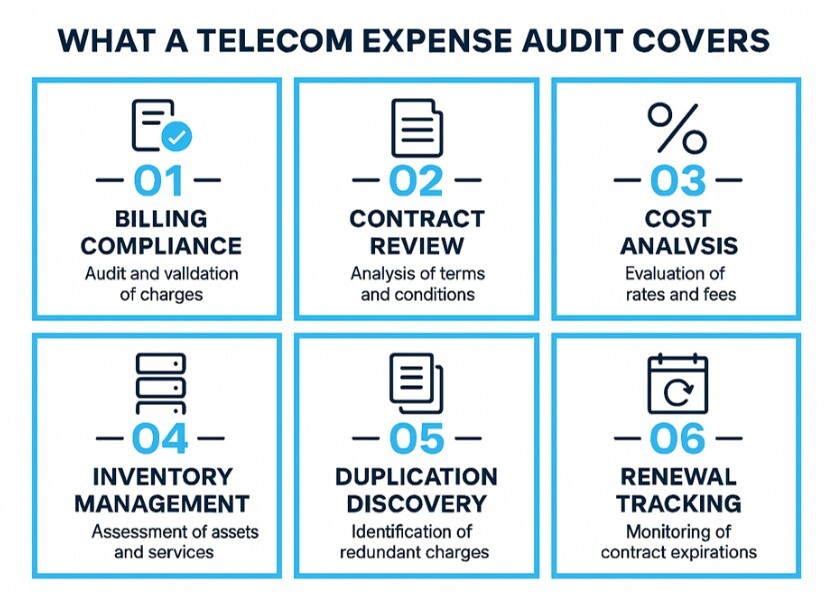
What a telecom expense audit covers
A thorough audit covers six areas. Skipping any of them leaves a category of errors undetected.
- Invoice validation: every line item on every carrier invoice checked against the contracted rate for that service. This is the core of the audit and the most time-consuming part.
- Contract compliance: rates, discounts, minimum commitments, and SLA credits checked against current contract terms. Carriers don't always apply contract amendments correctly, and they rarely flag it when they don't.
- Inventory reconciliation: carrier billing records cross-referenced against your active service inventory to identify ghost services — lines, circuits, and features still billing after disconnection.
- Tax and surcharge review: taxes and regulatory fees checked for correct jurisdiction, applicable exemptions, and accuracy against published rates. Tax errors compound quickly at scale and are easy to miss in invoice review.
- Duplicate charge identification: billing records reviewed for the same service appearing more than once in a billing period. Less common than rate errors but present often enough to check for.
- Contract and renewal review: active contracts checked for term dates, auto-renewal provisions, and rate structures that may have changed since signing.
How to run a telecom expense audit: step by step
Step 1: Gather 12 to 24 months of invoices from every carrier
Every carrier, every account number, every service type. PDF invoices, EDI files, online portal exports — whatever format each carrier provides. The scope is key: an audit that covers your primary carrier but misses secondary carriers will miss a proportionate share of errors.
Step 2: Pull your contract library
Every active agreement, including amendments, addenda, and rate schedules. Note where contracts are missing, expired, or where amendments exist without a clear master agreement to attach them to. Gaps in the contract library are gaps in the audit — you can't validate a rate you can't reference.
Step 3: Build or verify your service inventory
What you believe is active, by carrier, location, and service type. This becomes the baseline for inventory reconciliation in step 5. If your internal records haven't been maintained consistently, this step takes longer than expected. Pull carrier inventory reports to cross-reference against internal records rather than relying on internal records alone.
Step 4: Map invoices to contracts
Check billed rates against contracted rates for every service. This means opening the contract, finding the applicable rate table, and comparing it against what appears on the invoice line by line. Flag any discrepancy where the billed rate doesn't match the contracted rate, where a discount isn't applied, or where a charge exists for a service category not covered by the current contract.
Step 5: Reconcile billing against inventory
Identify any service appearing on an invoice that doesn't have a corresponding active record in your inventory. These are ghost service candidates. Each one needs a carrier-side investigation to confirm whether the service is still active or has been disconnected without a billing update.
Step 6: Prioritize findings by recovery value
Not every finding is worth the same effort to dispute. Rank by monthly charge and by how recently the error appeared. Errors within the carrier's dispute window — typically 90 to 180 days from invoice date — are recoverable. Errors outside that window may not be. Prioritize recent, high-value findings first.
Step 7: File disputes and disconnect requests
For each finding, initiate the appropriate carrier process. Rate errors require a billing dispute with documentation of the contracted rate being violated. Ghost services require a confirmed disconnect order and a credit request for charges billed after the disconnection date. Track each dispute separately. Carriers don't proactively close disputes — they need to be followed up on.
What a telecom expense audit typically finds
The specific findings vary by organization, but five categories appear consistently across enterprise telecom environments.
- Billing errors: rates applied incorrectly after a contract amendment or renegotiation. Present in the majority of enterprise environments, particularly where contracts have been renegotiated in the past 18 months and the carrier's billing system wasn't updated to match.
- Ghost services: circuits, lines, or features still billing after disconnection. Almost always present in environments with multiple carriers, high staff turnover, or locations that have moved or closed. Individual charges are often small enough to pass without scrutiny; collectively they add up.
- Tax errors: incorrect jurisdiction, exemptions not applied, surcharges on exempt services. A non-profit or government entity that qualifies for telecom tax exemptions but hasn't filed exemption certificates with every carrier is a common example. The error repeats every month until someone finds it.
- Contract non-compliance: discounts not applied, SLA credits owed but not issued, minimum commitment calculations that don't match the contract. Carriers calculate minimums based on their billing system logic, which doesn't always match what the contract says.
- Auto-renewed contracts: agreements that rolled into a new term at pre-renegotiation rates because no one flagged the renewal date. Often the single highest-value finding in a first audit, because the financial impact compounds for the full length of the new term.
Organizations running a first structured audit against contracted rates typically find billing errors in the 8 to 15 percent range of audited spend. The total is rarely zero, and for enterprises that haven't run a structured audit in more than two years, it's rarely small.
What to do with what you find
The audit produces findings. Three actions follow in order.
- File disputes within carrier windows. Most carriers allow 90 to 180 days from invoice date to dispute a charge. Start with the most recent errors at the highest monthly value. Older findings outside the dispute window may still be worth raising with the carrier — some will negotiate recoveries on a goodwill basis — but don't count on it. Document everything: the specific charge, the contract clause it violates, and the date the dispute was filed.
- Disconnect confirmed ghost services. Get written confirmation of disconnection from the carrier and track the billing change in the next cycle to verify it cleared. Carriers confirm disconnections and then continue billing more often than they should. The disconnect isn't complete until the charge stops appearing on the invoice.
- Build a process to prevent recurrence. A point-in-time audit produces a clean snapshot. Without an ongoing validation process, the same error categories reappear within a few billing cycles. Rate errors come back when the next contract amendment goes in. Ghost services accumulate again as staff turn over. Monthly invoice validation against contracted rates is the structural fix instead of a periodic cleanup exercise, but a routine that runs every billing cycle before payment clears.
When to use a managed service instead
Running a one-time audit internally is feasible for organizations with dedicated telecom management resource and the time to gather carrier data, build a contract library, and reconcile inventory from scratch. For most IT teams, that's a significant project on top of existing workloads.
The bigger challenge is what comes after. Dispute management across multiple carriers is ongoing work. Each carrier has its own dispute process, its own documentation requirements, and its own timelines. Tracking five or six open disputes simultaneously while running next month's invoice validation isn't something that fits easily into a stretched IT or finance team's bandwidth.
Pure IP FinOps runs the full audit process and maintains it monthly. Inventory reconciliation, invoice validation against contracted rates, dispute filing and tracking, contract monitoring — managed by a dedicated support lead who knows your carrier mix and your contract terms. The audit findings land on your desk. The audit work doesn't.
Frequently asked questions
What is a telecom expense audit?
A telecom expense audit is a systematic review of carrier invoices against contracted rates, active service records, and inventory. It identifies billing errors, ghost services, contract non-compliance, and tax errors — each with a dollar value and a recommended action. A point-in-time audit reviews a defined historical period. An ongoing audit process validates every invoice in the billing cycle it arrives.
How long does a telecom expense audit take?
A point-in-time audit covering 12 to 24 months of invoices across multiple carriers typically takes four to eight weeks to run thoroughly internally, depending on how complete the contract library is and how much carrier-side data needs to be gathered. The most time-consuming steps are contract reconciliation and inventory verification. A managed service with existing carrier relationships and tooling can compress this significantly.
How much can a telecom expense audit save?
Organizations running a first structured audit against contracted rates typically find billing errors in the 8 to 15 percent range of audited spend. For an enterprise spending $1M annually on telecom, that's $80,000 to $150,000 in identified errors. Not all of it will be recoverable — errors outside carrier dispute windows may not be credited — but the ongoing savings from catching errors before payment clears compounds month over month.
How often should you audit telecom expenses?
Every billing cycle. A monthly audit process that validates every invoice against contracted rates before payment clears catches errors in the period they appear, before dispute windows close and before incorrect charges compound. An annual audit is better than nothing. It finds twelve months of errors after payment has already cleared on most of them.
What's the difference between a one-time telecom audit and ongoing telecom expense management
A one-time audit produces a snapshot of what went wrong over a defined period and a list of recovery opportunities. Ongoing telecom expense management validates every invoice monthly, maintains an accurate service inventory, tracks contracts and renewal dates, and files disputes as errors appear. One is a project. The other is a governance process.
If your telecom spend hasn't been audited against contracted rates in the last twelve months, the audit will find something.
Clients using Pure IP FinOps save on average 20% of their network spend.
Book a call with an expert to learn more and see a demo.

.png?width=405&height=200&name=Cloud-based%20phone%20systems%20for%20large%20businesses%2c%20explained%20(1).png)