
Telecom expense management has a marketing problem. Vendors use the term to describe everything from basic invoice consolidation software to fully managed services that handle carrier disputes and maintain live inventory across your entire network. The category sounds coherent. The actual range of what's on offer is wide enough that two organizations can both say they have a TEM service and mean completely different things.
This guide is for IT leaders who want to understand what telecom expense management should cover, where most platforms stop short, and how to evaluate a managed TEM service before committing to one.
What telecom expense management covers
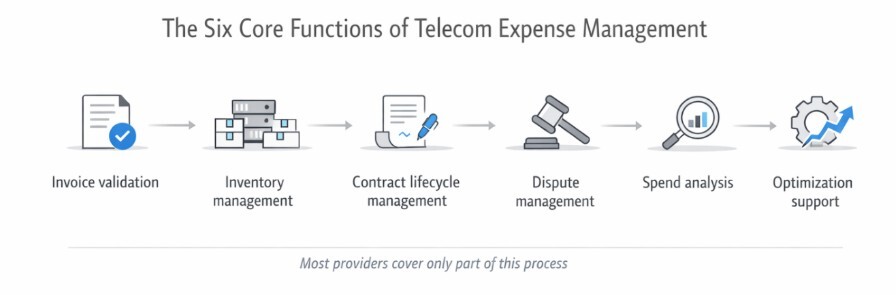
Telecom expense management is the ongoing process of controlling what an organization pays for communications and network services. Done properly, it covers six distinct functions.
- Invoice validation: Collecting invoices from every carrier and checking them against contracted rates before payment clears
- Inventory management: Maintaining an accurate record of every active service, reconciled against what carriers say is billable
- Contract lifecycle management: Tracking every active agreement, its terms, and its renewal dates
- Dispute management: Identifying billing errors and resolving them directly with carriers
- Spend analysis: Producing structured data across carriers, locations, and cost centers that finance and IT can use
- Optimization support: Using that data to benchmark rates and support renegotiations
Most TEM platforms address invoice management and spend analysis reasonably well. The middle four functions are where the gaps open up.
What most TEM platforms deliver
TEM platforms have improved significantly over the past decade. The better ones consolidate invoices from multiple carriers into a single interface, normalize spend data across formats, and produce dashboards that give finance and IT a shared view of what the organization is paying.
That's useful. It's also a lower bar than most buyers realize when they're evaluating.
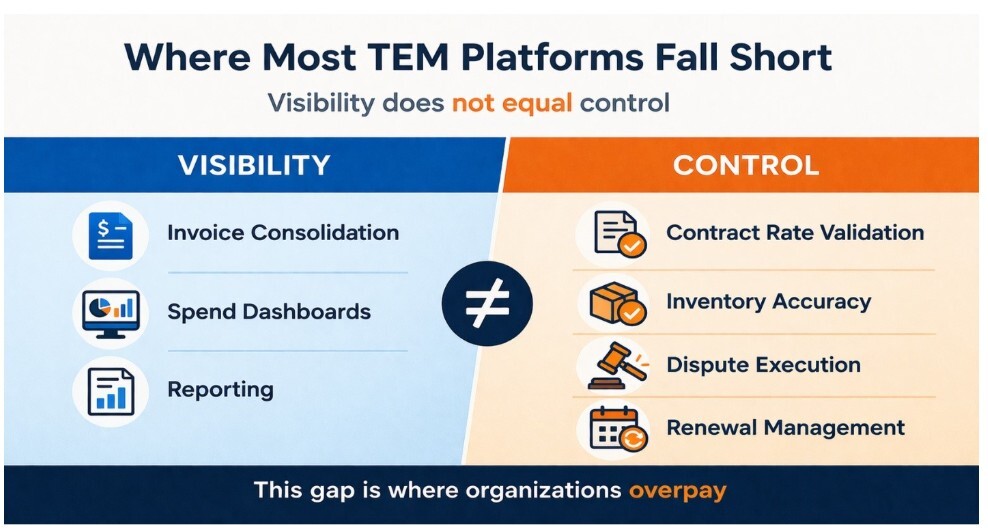
Invoice consolidation is not invoice validation. A platform that aggregates invoices and flags spend anomalies above a threshold will catch a circuit that doubled in cost. It won't catch a circuit billed at the wrong rate because a contract amendment from eight months ago never made it into the carrier's billing system. The charge looks normal. It just isn't.
Spend reporting is not spend governance. A dashboard that shows last month's telecom costs by carrier and location tells you what happened. It doesn't tell you whether you should have paid it, whether a disconnected service is still on the invoice, or whether a contract rolled into auto-renewal at a rate that was set three years ago.
The gap between visibility and control is where most organizations quietly overpay.
Platform vs. managed service: what the difference means in practice
The distinction between a TEM platform and a managed TEM service matters more than vendors typically make clear.
A platform gives your team tools. It surfaces data, flags anomalies, and produces reports. Someone on your team has to decide what to do with that information, execute against it, and manage the carrier interactions that follow. For organizations with a dedicated internal telecom manager, that can work. Most enterprises don't have one.
A managed service provides a team that does the ongoing work. Invoice validation runs every month without anyone inside your organization initiating it. Disputes get filed by the service provider, not flagged for your team to handle. Inventory gets updated when services change. Contracts get monitored, with alerts before renewal windows close.
The table below maps the practical difference across the six TEM functions:
| Function | TEM platform | Managed TEM service |
| Invoice consolidation | Yes | Yes |
| Spend reporting | Yes | Yes |
| Invoice validation against contracted rates | Partial, rule-based | Every invoice, every cycle |
| Dispute filing | Flags for internal team | Filed and managed on client's behalf |
| Inventory maintenance | Client-maintained | Managed and updated continuously |
| Contract renewal alerts | Some platforms | Proactive, with dedicated oversight |
| Named support contact | No | Yes |
The practical implication: a platform transfers the workload to your team. A managed service removes it.
What good telecom expense management services look like
An IT leader who has never worked with a well-run managed TEM service may not have a clear picture of what the output should look like month to month. These are the things a managed TEM service should be delivering consistently.
- Monthly audit results with specifics. Not a summary that says spend was within normal range. A report that identifies errors caught, amounts in dispute, disputes resolved in the period, and any services flagged for investigation. If the monthly output doesn't include specific findings, the audit isn't running at the line-item level.
- An inventory that reflects what's active right now. Telecom environments change continuously: services are added, modified, and disconnected every month. An inventory that isn't updated when those changes happen becomes useless as a validation tool within a few billing cycles.
- A contract calendar with enough lead time to act. Renewal alerts that arrive 30 days before a notice window closes aren't useful if renegotiating a contract takes six weeks. A managed TEM service should surface renewal dates far enough in advance to give the organization a genuine choice about what to do.
- A named contact who knows the environment. Someone who can answer a specific question about a specific circuit without being briefed from scratch every time. The value of a named support lead compounds over time as they build familiarity with your carrier mix, your contract terms, and the history of your account.
- Spend data in a format that's usable outside the platform. Structured by carrier, location, service type, and cost center, in a format that finance can work with for budget forecasting and that IT can use to support a benchmarking conversation with a carrier. Raw invoices reformatted into a dashboard are not the same thing.
Why IT leaders end up with the wrong TEM service
Most TEM purchasing decisions get made under time pressure, by someone who is already managing too many vendor relationships and needs to solve the telecom management problem quickly. A few patterns explain how organizations end up with a service that doesn't deliver.
- Buying on dashboard quality. TEM platforms are good at demos. A well-designed interface with clean spend visualization is easy to show. Whether the platform validates invoices against contracted rates, maintains inventory accurately, or manages disputes effectively is harder to evaluate in a 45-minute call.
- Underestimating the internal resource requirement. A platform that requires an internal telecom manager to operate effectively is only useful if that manager exists. Organizations that buy a platform assuming the software does the work often find the software does the reporting and the work still falls on IT.
- Treating the first audit as the ongoing state. A TEM service that runs a thorough initial audit and then moves to lighter-touch monthly processing is not the same as one that runs a full invoice validation every cycle. Ask specifically what the ongoing monthly process covers, not just what onboarding looks like.
- Assuming carrier expertise transfers. A provider with strong IT expense management credentials may have limited knowledge of carrier billing systems, dispute processes, and contract enforcement. Telecom billing disputes require carrier-specific knowledge that doesn't come from general IT finance experience.
What to ask before signing a TEM services contract
Seven questions worth putting to any managed TEM provider before committing.
- Is invoice validation automated or manual, and does it cover every line item or a sample?
- Who maintains the service inventory after onboarding, and what process updates it when a service changes?
- When you identify a billing error, does your team file the dispute or does that come back to us?
- How far in advance do contract renewal alerts go out, and what does the alert include?
- Who is our named contact, and what is their direct scope of responsibility?
- What does our spend data look like at the end of month one, and can we export it in a format we choose?
- What did a first audit find for an organization with a similar carrier mix and spend profile to ours?
The last question is the most telling. A managed TEM provider that can't point to specific findings from comparable clients either hasn't run enough audits or doesn't track results in a way that suggests they're doing the work thoroughly.
Where Pure IP FinOps fits
Pure IP FinOps is a managed telecom expense service built to cover all six TEM functions, not just the two that platform-only tools handle well.
Every invoice is validated against contracted rates in the billing cycle it arrives. The service inventory is maintained continuously and reconciled against carrier billing monthly. Disputes are filed and tracked by Pure IP FinOps's team. Every active contract is visible in one place, with renewal alerts before notice windows close. Spend data is normalized across carriers, locations, and cost centers and available in a format finance and IT can use.
A dedicated support lead owns the ongoing relationship. The monthly output is specific: errors caught, disputes open, disputes resolved, inventory changes, contracts approaching renewal. Beyond a dashboard summary, it gives you a working record of what happened and what's being done about it.
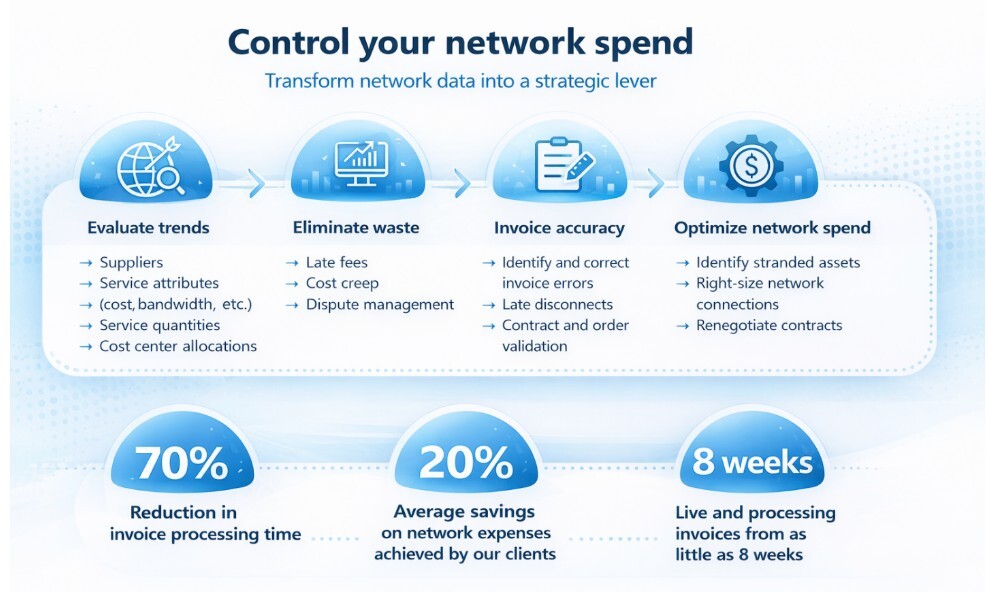
The impact of Pure IP FinOps:
Frequently asked questions
What is telecom expense management?
Telecom expense management is the ongoing process of controlling what an organization pays for communications and network services. It covers invoice validation, inventory management, contract tracking, dispute resolution, and spend analysis. The goal is to make sure every charge on every carrier invoice is accurate, every active service is accounted for, and every contract is visible and actively managed.
What's the difference between a TEM platform and a TEM managed service?
A TEM platform gives your team tools to manage telecom spend. A managed TEM service provides a team that does the management work on your behalf. For organizations without dedicated internal telecom management resource, a platform surfaces the problem. A managed service resolves it.
How much does telecom expense management cost?
Pricing varies by provider and model. Some charge per line or per location; others use a flat monthly fee or a percentage of spend under management. The relevant comparison is cost against what the service recovers. Organizations running a first structured audit under a managed TEM service consistently find billing error recovery offsets the cost within the first few billing cycles.
What should I expect in the first 90 days of a TEM service?
Onboarding should cover inventory setup across all carriers, contract library collection, and a baseline audit of recent invoices against contracted rates. By day 90, you should have an accurate inventory, a contract calendar with renewal dates, an initial audit finding with specific errors identified, and a clear picture of what the ongoing monthly process covers.
Do I need a TEM service if I already have a FinOps platform?
Most FinOps platforms are built for cloud spend and don't cover carrier invoice validation, telecom inventory management, or billing disputes. If your FinOps platform doesn't explicitly address these, your telecom spend is outside its coverage. A managed TEM service covers the gap without requiring changes to your existing FinOps tooling.
Telecom spend without a governance process is a slow drain on resources.
Pure IP FinOps runs the audits, files the disputes, and maintains the inventory every month, across every carrier.
Download the datasheet to see what the managed service covers, then book a discovery call to find out what we find in your environment.

.png?width=405&height=200&name=Cloud-based%20phone%20systems%20for%20large%20businesses%2c%20explained%20(1).png)